
Insights from the CIO
Founder, Chairman, and Chief Investment Officer
Investment Takeaways
-
Low-volatility and dividend-oriented equities are trading at 15-year relative valuation lows, even as the S&P 500 sits near record high and elevated multiples
-
Narrow leadership and rising concentration mean many portfolios share the same crowded exposures, increasing hidden downside risk.
-
Stability is out of favor and being underpriced. The market is paying up for excitement and discounting steady cash flows, income, and downside protection.
-
When stability is inexpensive, investors can strengthen portfolios and position for a broader range of outcomes. The goal is not to predict a turning point, but to be prepared for one.
Perspectives on the Market
Every market has a price for safety. In the insurance world, it is the premium paid before the storm. In the stock market, it’s typically the valuation gap between steady compounders and high-flyers, or the price investors are willing to pay for ballast over beta.
Historically, that price was meaningful. Investors seeking lower volatility, reliable dividends, and defensive characteristics accepted richer valuations for the privilege. In effect, safety carried a cost.
Today, the equation has flipped. After three years of a narrow, momentum-driven rally that rewarded speculation and punished restraint, the “cost of stability” has collapsed. Low-volatility and dividend-focused strategies are trading at their cheapest relative valuations in 15 years, while the S&P 500 sits near record highs and at elevated multiples. For investors seeking to remain fully invested while reducing vulnerability, this is an unusual and attractive setup.

Source: Source: FactSet. Data from 5/31/2011-12/31/2025. Relative valuation based on Forward P/E Weighted Harmonic Average. S&P 500, S&P 500 Low Volatility, & S&P 500 High Dividend data sourced from ETF. The Income Equity product is typically compared to the Russell 1000 Value Index. Any comparison to the Russell 1000, S&P 500, or their corresponding ETFs, is for illustrative purposes only. Past performance should not be taken as a guarantee of future performance.
Safety on Sale
The last several years rewarded risk-taking. High-beta stocks dramatically outperformed lower-volatility peers, reinforcing the belief that stability was unnecessary—or worse, a drag on returns. The rally off the April 2025 tariff-scare lows was among the most beta-driven in history: downside protection proved valuable during the drawdown, but the ensuing V-shaped recovery favored speculation. The result is a market where caution has been penalized and risk-taking rewarded, creating one of the widest gaps between high-beta and low-volatility strategies in over a decade. Low-volatility strategies, which once traded at a premium, now sit at historically wide discounts. Dividend-oriented equities tell a similar story.
In effect, the market is overpaying for excitement and underpaying for resilience. In our experience, this kind of extreme apathy toward defensive positioning rarely persists. When investors crowd into the same trade, the neglected corners of the market often become fertile ground for long-term opportunity.
When Different Becomes Defensive
As stability has cheapened, risk has grown more concentrated. Leadership within U.S. equities remains narrow, valuations are elevated, and correlations across popular exposures have risen. Many large-cap indices appear diversified, yet in practice they rely heavily on the same handful of mega-cap stocks.
This concentration creates asymmetry. Upside may remain, but downside risks are increasingly shared. When the same stocks dominate passive vehicles, diversification becomes more fragile than it appears.
We measure independence using Active Share, a gauge of how much a portfolio differs from its benchmark. Over time, many large-cap offerings have drifted closer to the S&P 500. For example, NASDAQ’s active share has declined from 74 to 48 over the past decade.
By contrast, defensive cohorts have remained meaningfully distinct. Low Volatility and High Dividend indices maintain active shares in the 80s and 90s. Our Income Equity portfolio, with an active share of 83, is intentionally positioned apart from the herd. In a more homogenous market, that difference can matter.

Source: FactSet. Data as of 12/31/2025. Past performance should not be taken as a guarantee of future performance. S&P 500, S&P 500 Low Volatility, & S&P 500 High Dividend data sourced from ETF.
Stability Without Standing Still
Critically, stability does not have to mean stagnation. Dividend-paying and lower-volatility businesses tend to generate a greater share of total return from earnings and income rather than valuation expansion. That may feel less exciting during momentum-driven rallies, but it has historically proven more reliable over full cycles—especially when starting valuations are elevated.
That said, not all defensive strategies are created equal. Traditional low-volatility approaches often concentrate heavily in classic defensive sectors, prioritizing stability at the expense of future earnings growth. High-dividend strategies can sacrifice business quality in pursuit of yield and are similarly prone to sector concentration. Both can play a role, but neither is without trade-offs.
As active, bottom-up investors, we are not forced to accept those compromises. Our Income Equity portfolio delivers low-volatility characteristics alongside stronger earnings growth and a competitive dividend yield, while maintaining a more balanced sector profile. In our view, combining differentiated quality with reasonable valuations better prepares portfolios for a wider range of outcomes than passive defensive alternatives.
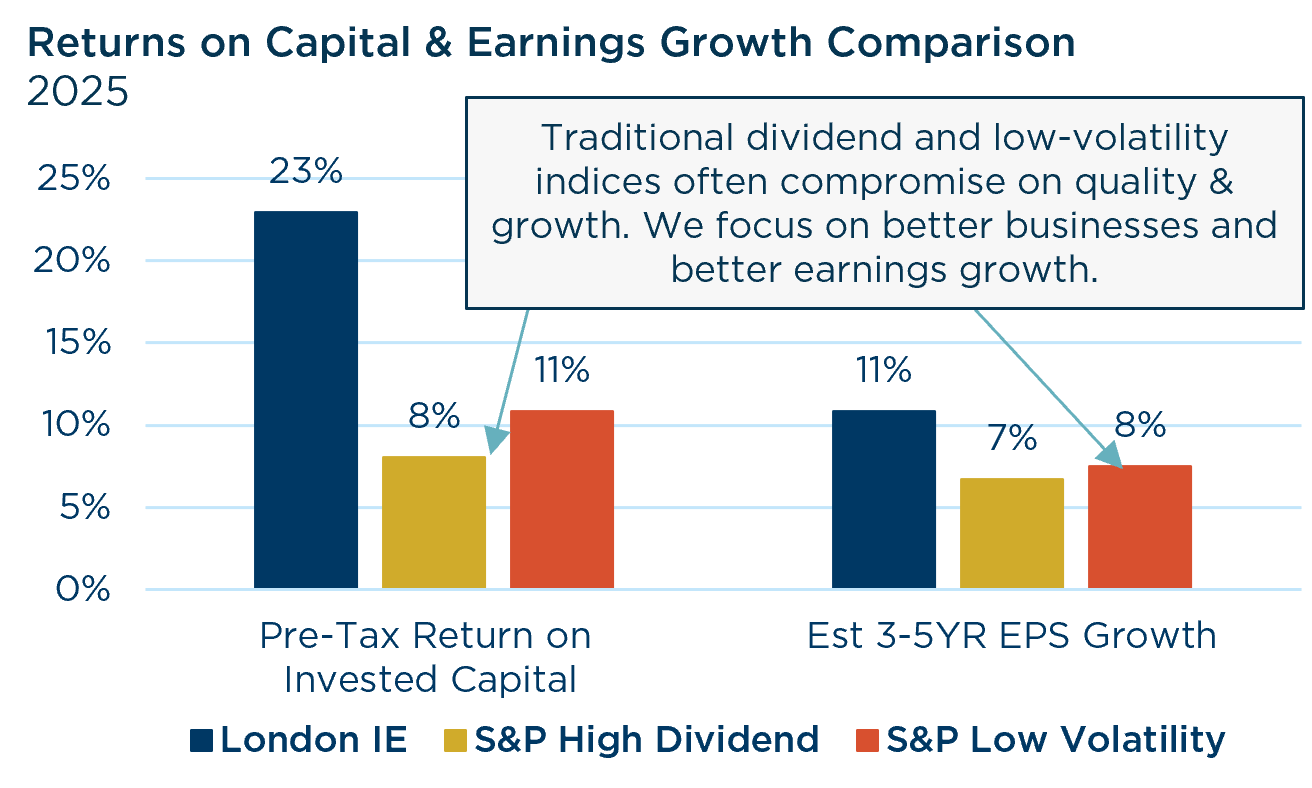
Source: FactSet. Data as of 12/31/2025. Past performance should not be taken as a guarantee of future performance. S&P 500, S&P 500 Low Volatility, & S&P 500 High Dividend data sourced from ETF.
In Summary
Markets swing between complacency and caution. Today’s environment reflects strong confidence that recent leaders will continue to lead and downside risks remain manageable. In that context, it is not surprising stability has been sharply discounted.
We view today’s backdrop as an opportunity rather than a warning sign. The relative cost of owning resilient companies able to compound through full cycles has rarely been lower. By focusing on durable businesses, reasonable valuations, and differentiated holdings, we believe investors can pursue competitive returns while mitigating the risks embedded in today’s concentrated market. The goal is not to predict a turning point, but to be prepared for one. Stability may not be exciting, yet when it is this inexpensive, it doesn’t need to be.
View Our Strategies
See the latest performance data