
To clients and friends of The London Company
Re-Shuffling the Deck
Executive Summary
- U.S. equities staged one of the sharpest turnarounds in years, with the S&P 500 posting its strongest quarter since 2020 on easing geopolitical tension and a resurgent AI trade.
- Semiconductors led the rebound, posting one of their best quarterly showings in decades, while June’s Russell reconstitution drastically reshuffled index composition across styles & down the cap spectrum.
- Our strategies broadly lagged their 85–90% typical upside capture in Q2, though Income Equity and Large Cap remain ahead of their primary benchmarks year-to-date due to strong downside protection and stock selection.
- We remain constructive, but believe today’s valuations, lofty expectations, and narrow leadership argue for a more measured return outlook ahead, reinforcing the case for quality and discipline.

There’s an old card player’s rule: the deck doesn’t remember who won the last hand. Markets needed the reminder this quarter, and for a while, nobody wanted to hear it.
The second quarter marked a dramatic reversal from the geopolitical anxiety that opened the year. The S&P 500 posted its strongest quarter in six years, fueled by continued AI infrastructure spending and a solid earnings season, with momentum accelerating in June as the U.S.-Iran peace deal eased energy prices and gave rates room to breathe.
Technology, the weakest sector to start the year, roared back to lead the market in Q2, and was the only sector to outpace the S&P 500. Underneath, the real action was in semiconductors, which posted their best quarter since the closing days of the dot-com bubble.
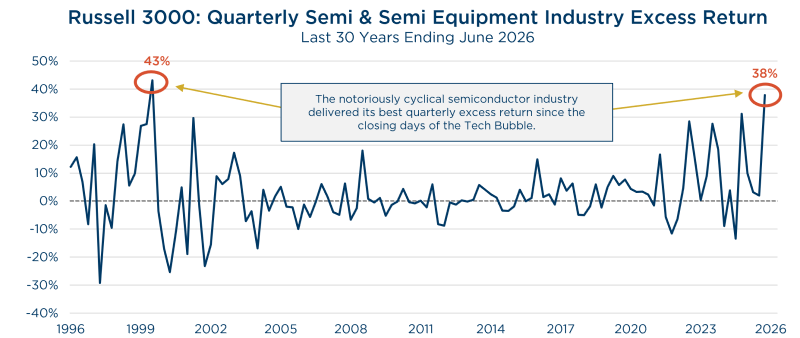
Source: FactSet. Quarterly data from 9/30/96 – 6/30/26.
That kind of move doesn’t happen without consequence for everything else. Semiconductors alone now account for nearly 20% of the S&P 500, up from roughly 3% for most of the last 15 years. Meanwhile, the weight of “everything else” has fallen to just over 80%, its lowest level on record. Technology overall now represents nearly 39% of the index; the semiconductor industry alone is a larger share of the market than the combined weight of the defensive sectors. We made a similar point in a recent CIO piece, “Empty Pews vs Crowded Casino Floor,” borrowing Warren Buffett’s image of a church with a casino attached. Lately, the casino has been loud.
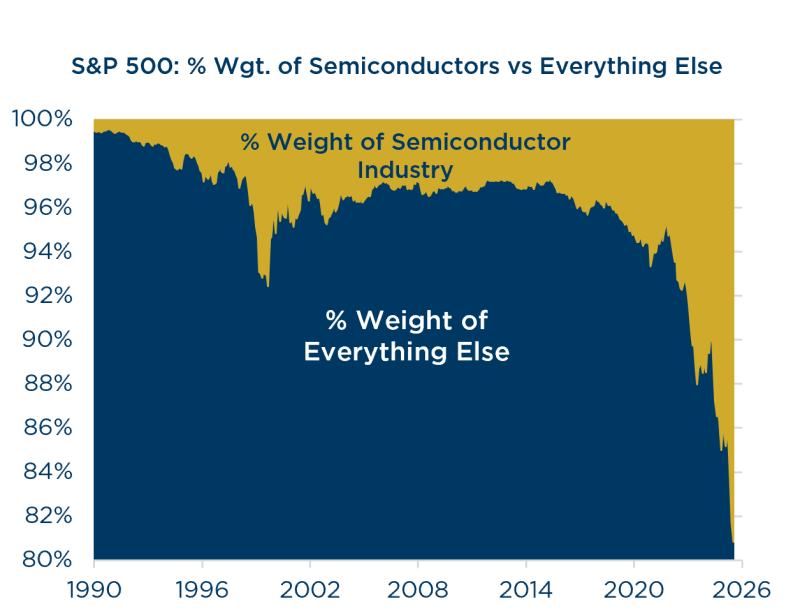
Source: Strategas. Data from 12/31/90– 6/30/26.
Just as we began making sense of that shift, the June Russell Index reconstitution reshuffled the deck outright. Semiconductor exposure in growth benchmarks went from roughly twice that of value benchmarks to more than ten times over. Moreover, the top 10 holdings in the Russell Mid Cap, 2500, and 2000 turned over almost entirely. With more than $12 trillion benchmarked to Russell’s U.S. indexes, that is not just a footnote. Investors who believe they hold a diversified mix of strategies might reasonably ask whether the hand they’re holding still looks like the one they were dealt ninety days ago.
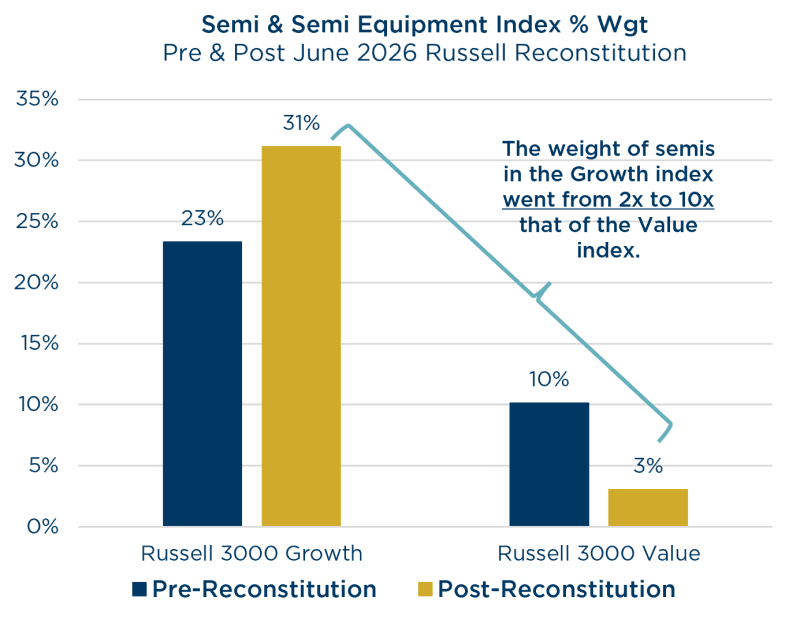
Source: FactSet. Data as of 6/26/26 & 6/29/26.
There’s a deeper story here too. For years, the mega-caps and hyperscalers funding this buildout were the exception in corporate America. They were capital-light, highly profitable, and generous with shareholder cash. That is changing. Several are now issuing equity and debt to finance AI infrastructure, and the free cash flow for some has turned negative even as their share prices climb. This quarter’s biggest gains accrued not to the check-writers footing the capex bill, but to the check-cashers on the other side of it, being paid to build it out. If those checks keep clearing, the picks-and-shovels trade keeps working. If they slow or the market starts asking harder questions about the return on all that spending, the reversion in these chipmakers and equipment suppliers could be sharp.
Strategy Recap
Our portfolios broadly fell short of our typical 85–90% upside capture target this quarter precisely because the market was dominated by names that don’t meet our quality threshold — cyclical memory, speculative small cap, and momentum-driven AI hardware. While our portfolios lagged amidst strong, double digit gains, we did experience some material green shoots in June as markets broadened and fundamentals garnered renewed focus. On a year-to-date basis, our Income Equity and Large Cap portfolios are notable bright spots. Both portfolios remain ahead of their respective benchmarks, due to notable downside protection in Q1 and strong stock selection, especially among our industrial tech & AI-tangential holdings.
Quality itself was not the problem. Down the market cap spectrum, only 25% of profitable companies in the Russell 2500 outperformed the index in Q2, a reminder that this rally rewarded momentum more than fundamentals. Historically, periods like this have proven mean reverting, which has often worked in our favor.
Our companies have largely continued to deliver attractive results while exhibiting sound capital allocation discipline. That has kept us highly convicted in our existing holdings, while opportunistically adding to a few names we believe are misunderstood or overlooked. Narrow themes and quick sentiment shifts driving short-term prices often create opportunities for long-term, fundamental investors like us.
Looking Ahead
Markets sit at or near all-time highs, and after three strong years plus a strong first half, many are asking whether the run can continue. Valuations are elevated, earnings expectations are high, and the S&P 500’s dividend yield sits near a multi-decade low. None of that predicts a downturn, but it does argue for more modest returns ahead than the recent past would suggest. Hot hands, in our experience, revert to the mean more reliably than most people expect, and when they do, the returns that hold up best tend to be the boring kind: durable earnings growth, real shareholder yield, and valuations that don’t require a flawless outcome to work. We believe high-conviction, genuinely differentiated active management is one of the better ways to know what’s really in your hand.
We believe high-conviction, genuinely differentiated active management is one of the better ways to know what’s really in your hand.
We’re not predicting when this hand ends, only that it will, and that the players still standing tend to be the ones who never confused a streak for a strategy. We would rather hold a smaller stack and a better hand than chase the pot.
As always, we appreciate and highly value the trust you have placed in us.
View Our Strategies
For more information