
Market Insights: Value Tech Mania — Near-Historic Russell 1000 Value Outperformance
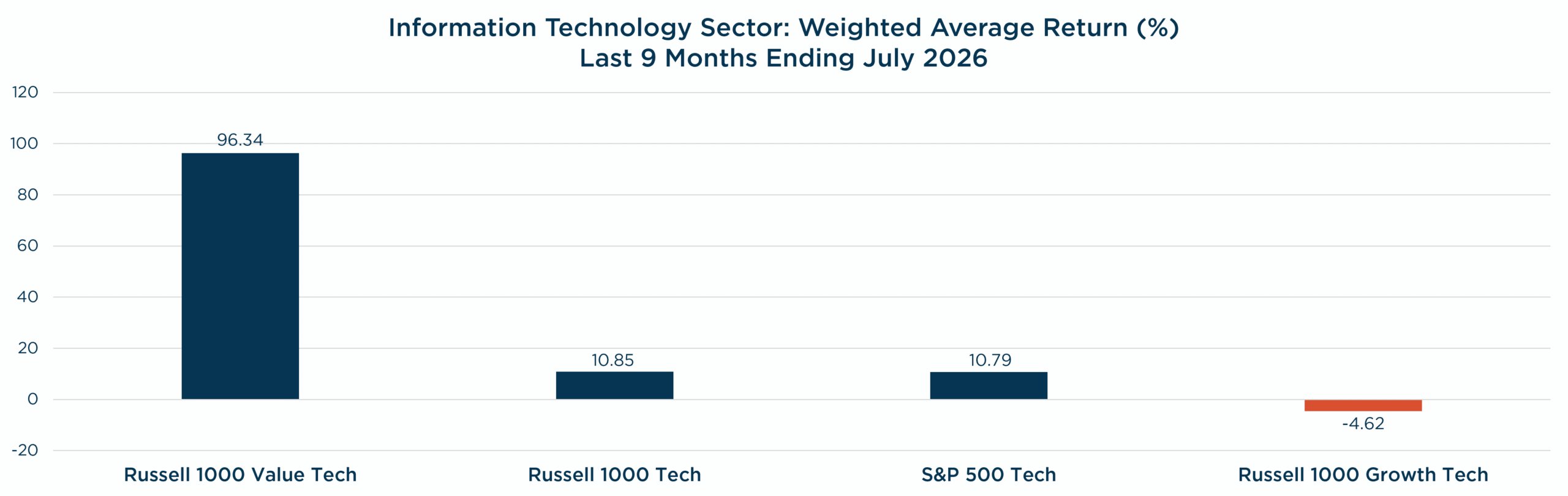
Source: FactSet.
A Historic Divergence
Over the nine months ending July, the Russell 1000 Value Index outperformed both the Russell 1000 and S&P 500 indexes by more than 14%, and outpaced the Russell 1000 Growth Index by more than 26%. Divergences of this magnitude between value and growth, occurring over such a short window, are rare. The last comparable episode took place in early 2001, as markets absorbed the aftermath of the late-1990s technology bubble.
For investors accustomed to years of growth and mega-cap technology leadership, this shift may appear to represent a healthy rotation toward more traditionally defensive, diversified segments of the market. A closer look at what has driven the move, however, tells a more nuanced story.
What’s Really Driving the Rally
Rather than reflecting broad-based strength across the sectors typically associated with value investing (Financials, Industrials, Energy, Health Care), this rally has been concentrated in a familiar place: Technology. Prominent value-index constituents such as Micron and SanDisk have posted outsized gains, and the effect has been dramatic. Over the trailing nine months, technology stocks within the Russell 1000 Value Index have outperformed technology stocks within the Russell 1000 Growth Index by more than 100%.
In other words, much of what looks like a rotation from growth to value has actually been a rotation within technology itself, from growth-classified technology names toward a narrower group of value-classified technology names. Investors allocating to value as a diversification strategy away from technology exposure may be surprised to learn how much of their value allocation’s return has come from that very sector.
Reconstitution Adds Fuel to the Fire
This dynamic has been further amplified by index reconstitution mechanics. Over the past month or so, several memory-related technology names were reclassified out of the Russell 1000 Value Index, based on the rules-based methodology index providers use to sort constituents into growth and value buckets. The timing proved consequential: shortly after these names exited the value index, they experienced a meaningful selloff.
Because these stocks had already been removed from the value benchmark, their subsequent decline weighed on the core and growth indexes without similarly affecting value’s return. The result was a further, mechanical widening of the value-versus-growth performance gap, driven not by fundamental repositioning within investor portfolios, but by the reshuffling that occurs each time index providers apply their style classification rules.
Concentration Wearing a Different Label
This episode arrives at a moment when broad index sector and stock concentration already sits at or near record levels across major U.S. equity benchmarks. Much of the recent discussion around concentration risk has centered on growth and core indexes, where mega-cap technology names dominate index weights.
The current value rally suggests that concentration risk is not confined to growth-oriented benchmarks. With 44% of the Russell 1000 Value Index’s nine-month absolute return attributable to the technology sector alone, the value benchmark itself has been driven by increasingly narrow factors. Investors who view a value allocation as an automatic source of diversification away from concentrated technology exposure may want to examine how much of that allocation’s recent return has, in fact, come from technology.
The Trouble with Rigid Style Definitions
At The London Company, we don’t believe in applying rigid, rules-based definitions of growth and value. Index providers typically classify securities using quantitative factors such as price-to-book ratios, earnings growth expectations, and other metrics, then rebalance those classifications periodically. This methodology can create meaningful turnover, even within strategies often described as “passive.”
Some of the market’s largest and most closely followed companies, including Meta, Alphabet, Amazon, and Apple, have made multiple cameo appearances across both growth and value benchmarks over the past several years, shifting classification as their valuation and growth characteristics evolved relative to index thresholds. This underscores a broader point: style labels are a function of index methodology, not necessarily a reliable indicator of a company’s underlying business characteristics or investment merit.
Our Approach: Quality and Valuation, Not Labels
While we remain aware of these rapidly shifting index dynamics, we don’t let them dictate our investment process. Our approach is designed to identify and own long-term quality compounders: businesses that feature elements of downside protection through both their fundamental strength and their reasonable valuations, regardless of how index providers happen to classify them at any given point in time.
We believe this discipline matters most during periods like the current one, when headline performance figures for a given style category may mask significant underlying concentration or narrow leadership. Investors evaluating their exposure to growth and value benchmarks may want to look beyond the label and examine what is driving performance beneath the surface, particularly during episodes of rapid or historically unusual divergence between the two.
As always, we encourage investors to consider these dynamics as one input among many when evaluating portfolio construction, and to consult with their investment advisor regarding how index concentration and style classification may affect their specific circumstances and objectives.
Read More Thought Capital
from The London Company