
To clients and friends of The London Company
The Jekyll & AI Market
Executive Summary
- The S&P 500 ended the quarter near record highs as strong earnings outweighed higher oil prices, higher yields, and the Fed’s first rate hike since 2023, but the index’s calm surface masked a market split in two.
- The quarter unfolded in two acts: a summer broadening that rewarded quality, followed by a sharp September reversal back toward mega-cap technology and energy.
- Our Small Cap and SMID strategies outperformed, while Large Cap, Income Equity, Mid Cap, and International trailed in a market fixated on oil prices & AI.
- We remain constructive on the economy but believe today’s concentration makes genuine differentiation scarcer and more valuable, and we are finding high-quality businesses at increasingly reasonable prices.

Halloween is the one night of the year when everyone gets to be two people at once. Robert Louis Stevenson gave us the original version, the upstanding Dr. Jekyll who became Mr. Hyde after dark. This year, the stock market got into costume early. Call it the Jekyll and AI market.
By daylight, the market looks every bit the respectable Dr. Jekyll: the economy is resilient, earnings continue to beat expectations, volatility is manageable, and the S&P 500 hovers near all-time highs. After dark, a more nuanced picture emerges. Spreads have widened sharply in the riskiest corner of the credit market. At the same time, more than half of S&P 500 constituents are in bear-market territory, down at least 20% from their all-time highs. Additionally, over 40% of constituents now carry a negative beta1 – more than double the prior peak set in 2000. A stock with a negative beta tends to move opposite its relative Index, meaning much of the index has been “zigging” while the handful of AI leaders driving performance “zag.”
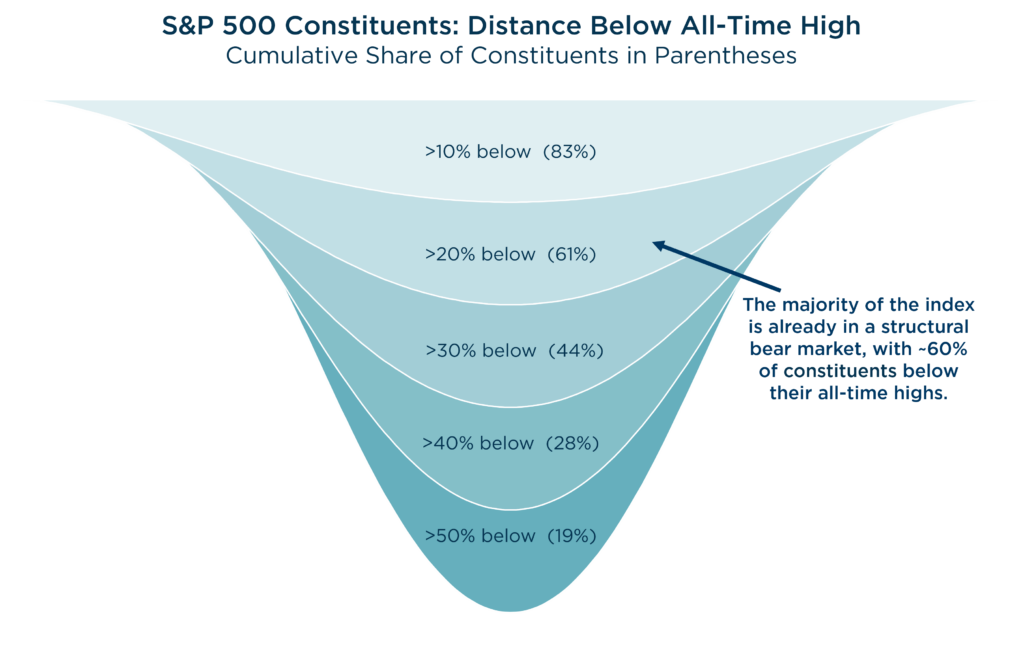
2Source: Piper Sandler. Data as of 9/30/2026.
1&2For more details, see Important Disclosures.
Earnings deserve most of the credit for the market’s respectable headline returns. Renewed conflict with Iran pushed crude higher, reviving inflation fears. Treasury yields followed, and in September the Fed raised rates for the first time since 2023. Powered largely by AI spending, corporate earnings have done the heavy lifting this year even as valuation multiples contracted. However, the higher rates climb, the harder it becomes for earnings alone to carry the load.
The third quarter itself played out in two acts. From late spring through August, the market broadened and businesses with real profits and strong balance sheets finally got some credit. Then September arrived, and Mr. Hyde came back out. Suddenly the market ran on seven stocks and a barrel of oil, as the Magnificent 7 and energy carried the indexes while the average stock fell.
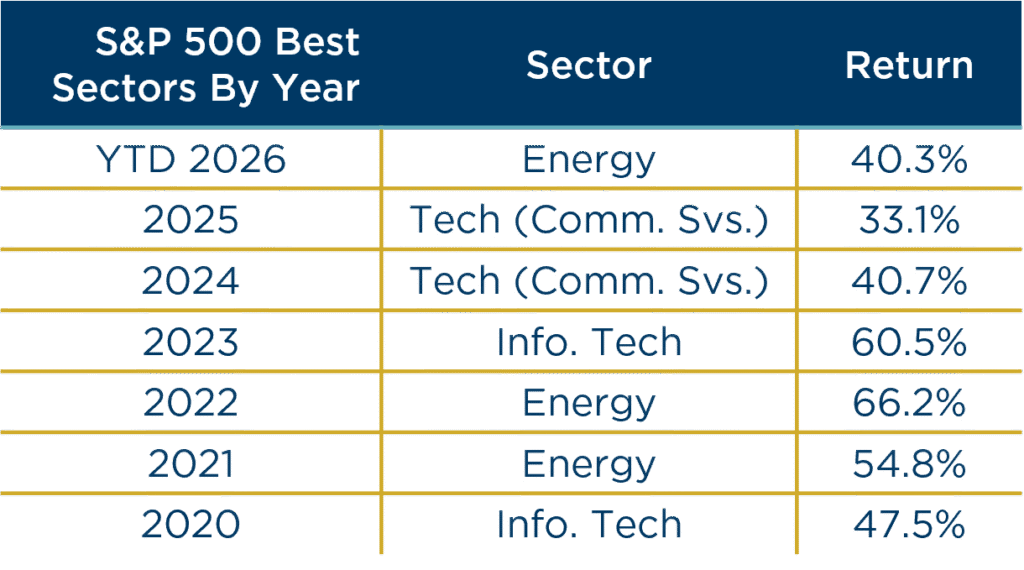
Source: FactSet. Data from 12/31/19 – 9/30/26.
This split personality is nothing new. Every year since 2020, the S&P 500’s best-performing sector has come from either AI-related technology or energy, two groups with little in common beyond their recent popularity. Markets like that reward well-timed tactical calls more than patient attention to fundamentals, and timing the market has never been a focus of ours.
The split runs deeper than stock prices. Technology’s weight in the S&P 500 sits near a record 40%, with several giant AI IPOs waiting in the wings. In the real economy, spending on data center construction has more than tripled since the end of 2023, while private construction everywhere else has shrunk, partly due to higher interest rates. History suggests markets rarely stay at record highs on the shoulders of so few for long. The long-awaited broadening may still be ahead of us, though it is unlikely to announce itself or travel a smooth path.
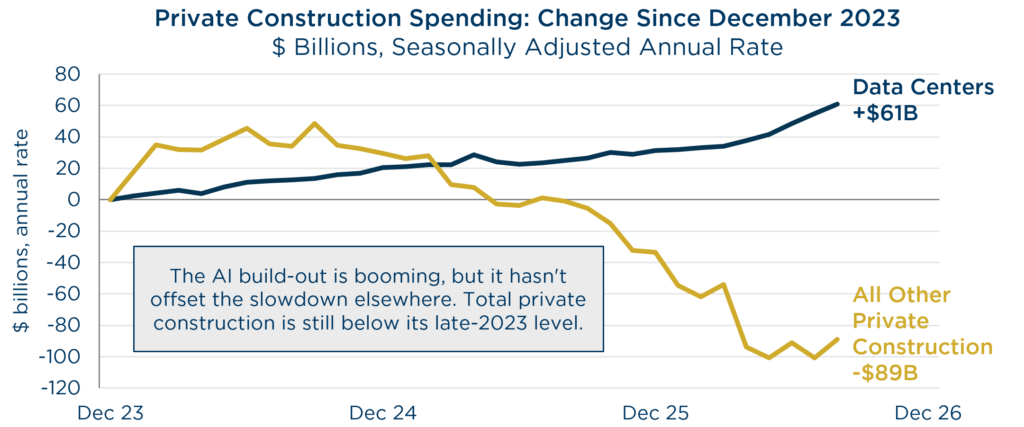
Source: U.S. Census Bureau, Value of Private Construction Put in Place. Monthly data from 12/31/23 – 8/31/26, seasonally adjusted annual rate. All other = total private construction less data centers.
Strategy Recap
Results across our portfolios were mixed. Our Large Cap and Income Equity portfolios fell short of our 85-90% upside capture target, giving back their first-half lead. A narrow group of mega-caps did most of the work, and higher-yielding corners of the market lagged as rates rose. The Russell 1000 Value index proved an especially tough opponent. June’s reconstitution removed several memory-chip makers just before they rolled over and pushed three of the market’s best-known tech companies to more than 15% of the index. When even the value benchmark puts on a growth costume, truly differentiated portfolios become scarce. We believe that scarcity makes being different more valuable, potentially providing ballast should the mega-cap AI trade stumble. The benchmark changed costumes. We did not.
Our Small Cap and SMID portfolios outperformed, holding up comfortably better than our downside target as their benchmarks declined. Rising rates and a return to quality cooled the speculative rally in smaller stocks during the summer months, and our lower-volatility approach held its ground when high-beta trading roared back in September. Mid Cap had a tougher quarter, falling more than its benchmark and outside our downside target. A strong rebound that began in late spring reversed in September, while underweights to energy and to previously beaten-down software stocks weighed on results.
International Equity also trailed, as leadership abroad rotated toward energy and banks, two areas where we find few businesses that meet our standards for durable, high-return economics. The same leadership has been a headwind all year. The silver lining is that quality has gotten cheaper: our valuation premium to the benchmark has narrowed considerably, even as our holdings’ returns on capital remain well above the index’s.
Looking Ahead
The economy remains on solid footing, but the headwinds have started to howl. Leadership could shift again with little warning.
Passive flows have reinforced concentration, and benchmarks once considered defensive now carry more technology exposure and volatility than their labels suggest. Meanwhile, many high-quality businesses outside the spotlight have quietly re-priced lower, creating what we believe are attractive opportunities for patient investors. If higher rates begin to pinch, the strain will likely appear first among lower-quality smaller companies reliant on floating-rate and short-term debt, exactly where strong balance sheets matter most.
Many high-quality businesses outside the spotlight have quietly re-priced lower, creating what we believe are attractive opportunities for patient investors.
Markets will keep switching personalities, and we won’t pretend to know which one shows up next. Our job is to focus on what we can control and own quality, reasonably priced businesses whose character doesn’t change with the market’s mood.
As always, we appreciate and highly value the trust you have placed in us.
View Our Strategies
For more information