
Insights from the CIO
Founder, Chairman, and Chief Investment Officer
Investment Takeaways
-
Same discipline. Same playbook. Two very different scoreboards this year. Our larger-cap strategies have outrun their Core benchmarks thus far* as broadening finally arrived. Meanwhile, our Small, SMID, & Mid Cap strategies have trailed—the cost of limited exposure to the speculative names driving Down Cap returns.
-
This broadening is the most sustained since ChatGPT’s 2022 debut reshaped markets. Its early shape is tracking the four prior post-concentration-peak episodes, precedents that ran for years rather than quarters.
-
Down Cap, the further you go, the more index returns have leaned on unprofitable companies rather than quality, the opposite of what our discipline is built to capture. That pattern has a history of reverting, and the data since May suggests it may already be turning.
-
Our portfolios remain well positioned to give clients exposure to the attractive growth and valuations of the Small & Mid Cap cohort, while limiting the low-quality pitfalls and elevated volatility typical of the asset class.
*Relative year-to-date performance from 12/31/25 – 8/31/26.
Perspectives on the Market
Football season has finally returned, and with it the promise of good teams, good coaching, and finishes worth remembering. Every playbook eventually runs into a scoreboard it doesn’t like. For us, the last two years haven’t been kind to any of the usual annualized time frames for our Down Cap strategies.
We spent the better part of eighteen months flagging that the market’s leadership was too narrow to last. This year it broadened. Up Cap, that broadening worked about the way a broadening should. Money rotated out of a handful of mega-cap winners into the rest of the market, and thus far* our larger-cap strategies have outpaced their core benchmarks as a result. Down Cap, the same broadening arrived, but our Small, SMID, and Mid Cap strategies lagged theirs.
Same playbook. Same coaches. Two very different scoreboards. That’s worth explaining, because the explanation is also the case for what comes next.
A Head Fake or the Real Thing?
We have seen several broadening ‘head fakes’ since ChatGPT’s November 2022 launch pulled markets into their current concentrated levels. These brief rotations faded within a quarter or two. That said, the first eight months of 2026 have delivered the most sustained broadening cycle yet. Following the four prior extreme concentration peaks of 1932, 1957, 1973, and 2000, smaller and more value-oriented equities outperformed the largest and growthier names by wide margins over the following three, five, and ten years. So far in 2026, a similar pattern is playing out. Equal-weight, small cap, and value styles have each outpaced their cap-weighted, large-cap, and growth counterparts, in proportions that roughly echo history. We aren’t predicting how long it lasts. However, if this broadening turns out to be the real thing rather than another false start, the historical precedent argues for a multi-year event rather than a couple good quarters.
The Further Down You Go
Over the past two years, Down Cap performance has tracked an unlikely variable: the higher the share of unprofitable index constituents, the stronger the returns. The past 24 months delivered a rate-cut relief rally in the most indebted names, a tariff deescalation & tax reform-fueled high beta surge, and an AI “picks and shovels” momentum trade. They all shared one trait: none of them cared whether a company was profitable, underscoring how speculation has been rampant.
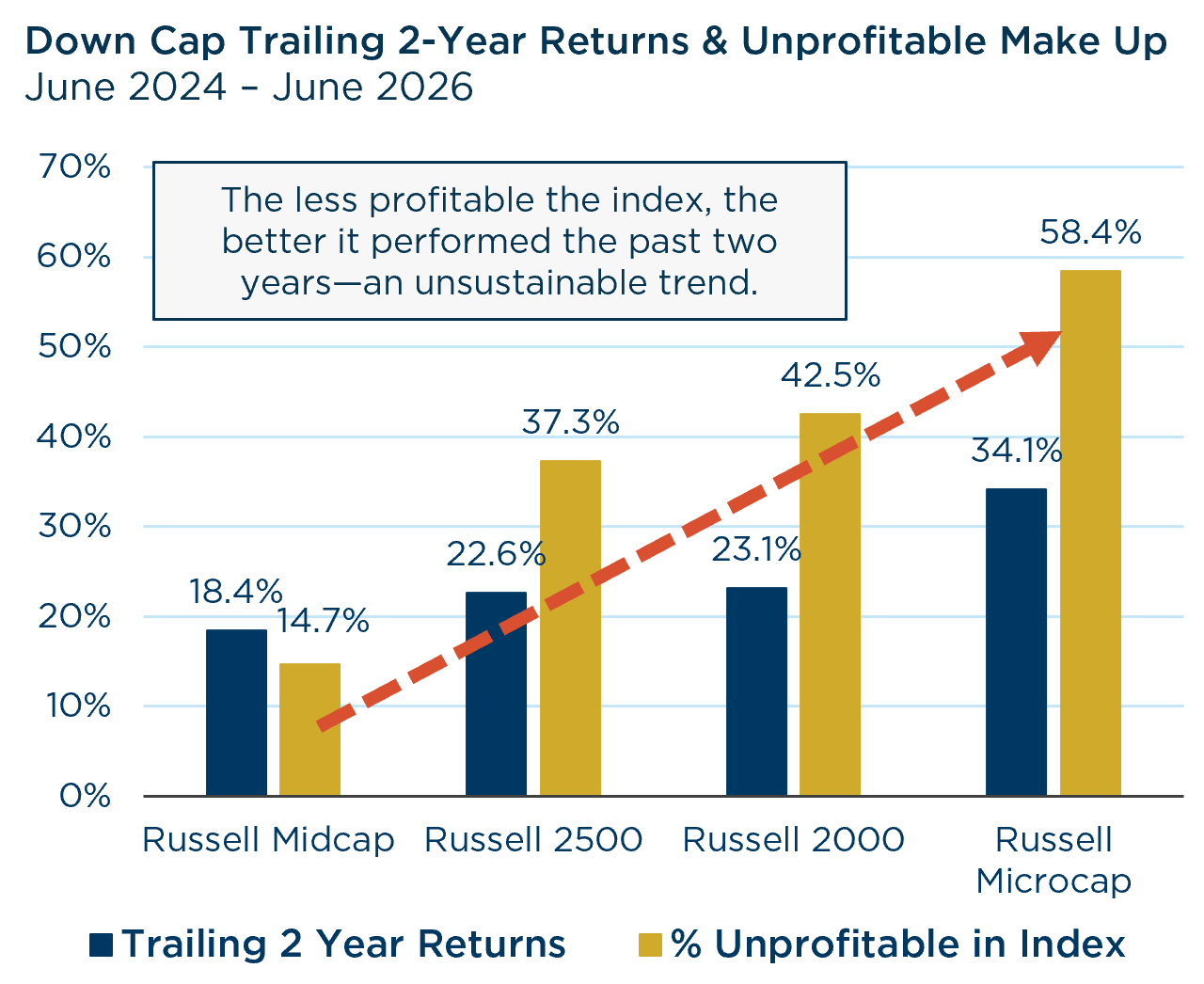
Source: FactSet. Performance data from 6/30/24 – 6/30/26. Past performance should not be taken as a guarantee of future performance.
We’ve Seen This Gameplay Before
This isn’t the first time quality has gone through a rough patch. As the chart below illustrates, profitable, higher-quality Small Caps have lagged by a similar margin four other times over the past 40 years. Each of the four prior troughs was followed by a rebound over the next 12 to 18 months. We can’t promise this time resolves identically, but history argues for staying the course rather than chasing what’s been working.
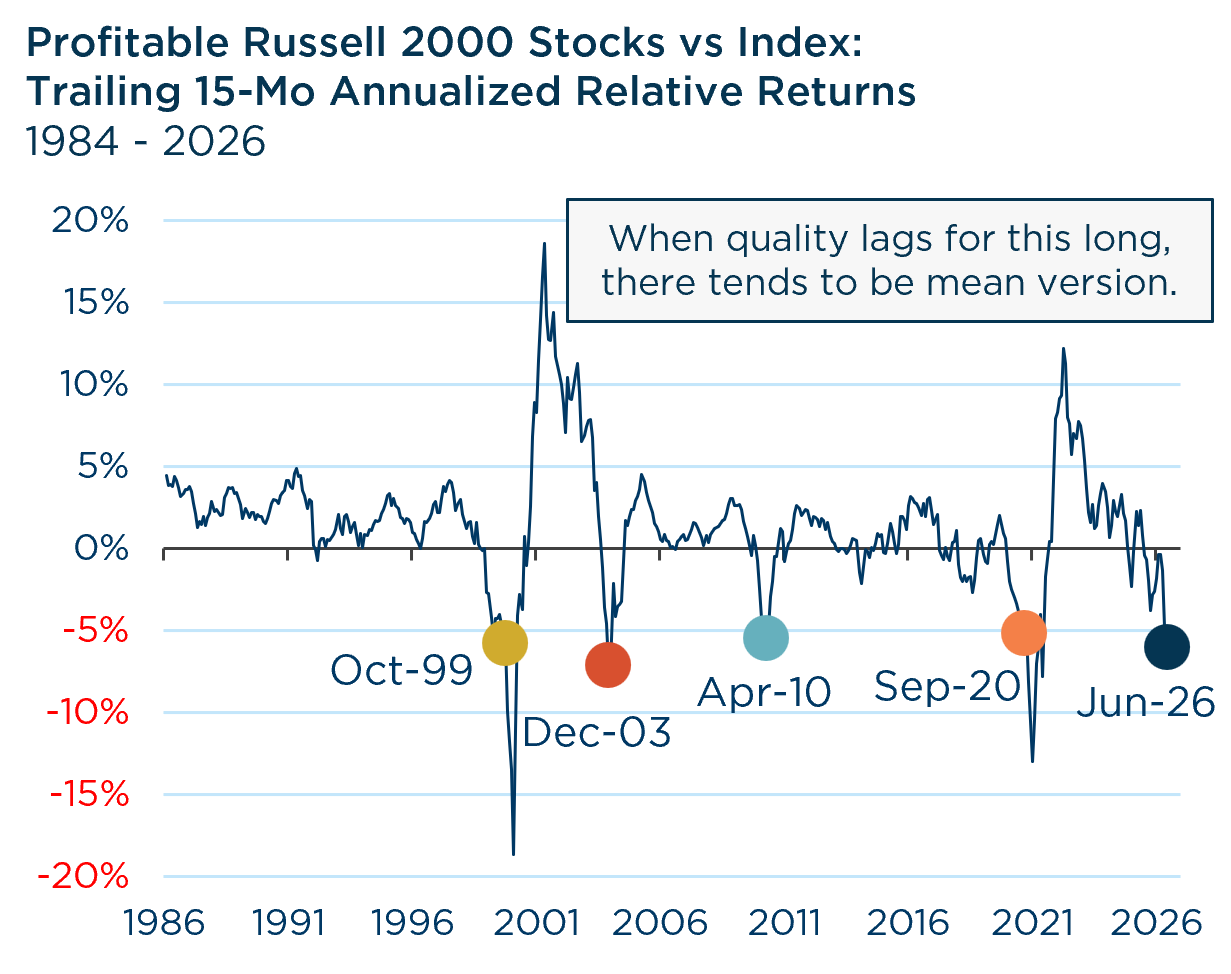
Source: Furey Research Partners; FactSet. Data from 2/28/86 – 6/30/26. Past performance should not be taken as a guarantee of future performance.

Source: Furey Research Partners; FactSet. Data from 2/28/86 – 6/30/26. Past performance should not be taken as a guarantee of future performance.
The Scoreboard Is Turning
The early data suggests that pattern may already be repeating. Since May 31, the Quality-at-a-Reasonable-Price factors we prioritize have outpaced the market’s negative-earnings, momentum, and high-beta cohorts Down Cap. A few months don’t make a trend, but it’s consistent with the kind of reversion the historical pattern would predict.
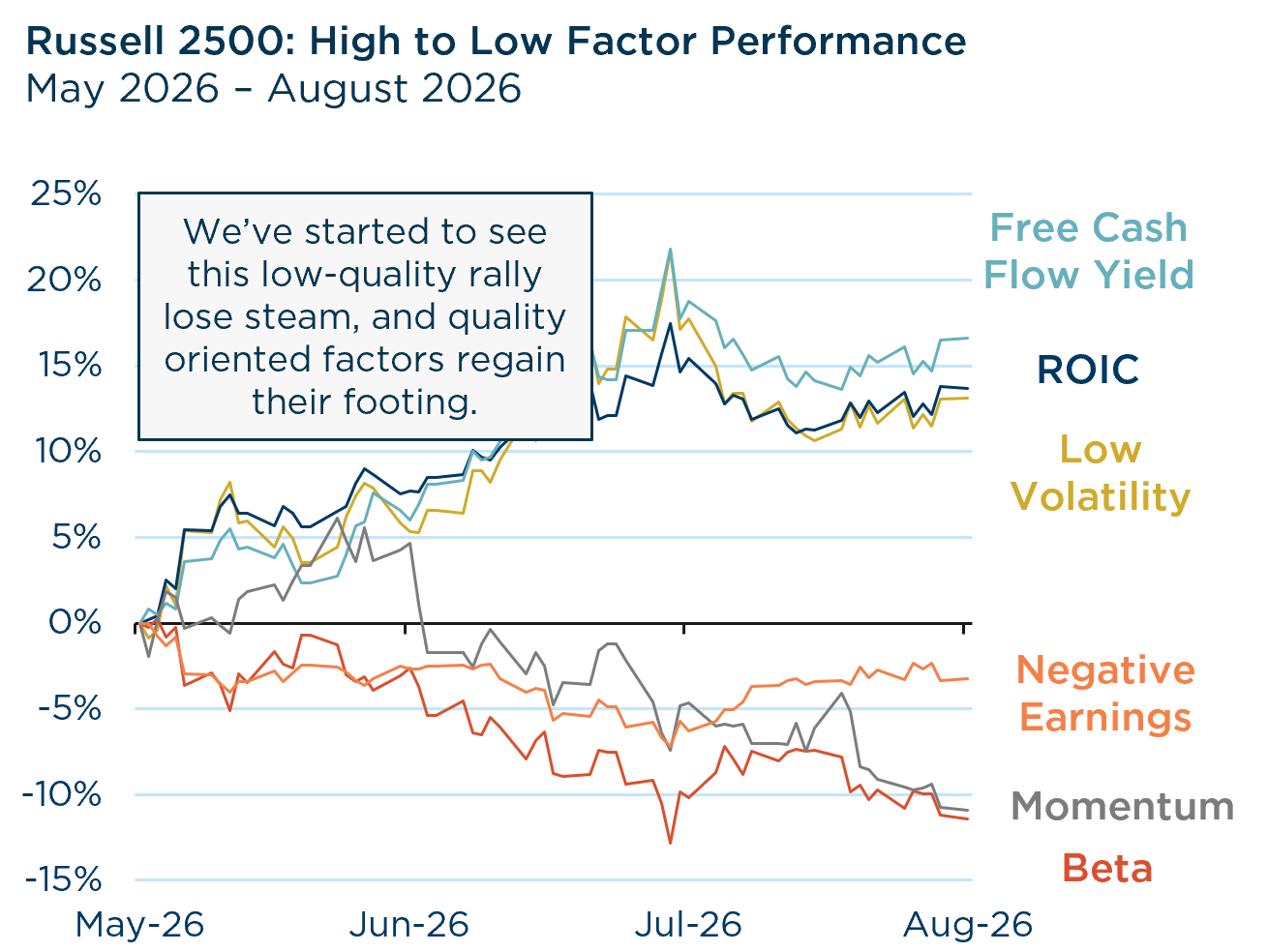
Source: Piper Sandler. Data from 5/31/26 – 8/31/26. Measures the forward price return of the companies in the Russell 2500 high & low quintile baskets of stocks by factor. Factors are sector neutral. Quintile baskets are rebalanced monthly at the beginning of each month. Past performance should not be taken as a guarantee of future performance.
The setup extends beyond factor performance. Correlations among Down Cap stocks have fallen while dispersion of returns has widened, a backdrop that has historically favored active management. Quality, having lagged for so long, also remains relatively inexpensive versus its own history, a silver lining for investors willing to look past the recent scoreboard.
This is also where the case for Mid & Small Cap equities, for active management, and for our approach comes together. The group trades at an attractive discount relative to their mega-cap counterparts. That said, Down Cap indexes have grown more leveraged, less profitable, and more concentrated in speculative names than a decade ago, making the case for a quality- oriented active manager even stronger. That’s the position active management is built to play, and it’s the role our Quality-at-a-Reasonable-Price discipline is built to fill.
In Summary
The broadening we anticipated has largely arrived, and Down Cap, the scoreboard is starting to catch up. If history is any guide, this broadening cycle could be a multi-year event, but that doesn’t mean it will follow a smooth path. Moreover, the double-digit broad market returns of the past three, five, and ten years may not repeat. In our view, companies with durable fundamentals, strong balance sheets, and reasonable valuations are best positioned to benefit as the cycle matures. The managers disciplined enough to tell them apart from the rest can capitalize on the opportunity. We’re not in the business of calling the turn — we’re in the business of being ready for one. Same playbook we’ve always run.
View Our Strategies
See the latest performance data