
Market Insights: Down-Cap Speculation May be Long in the Tooth
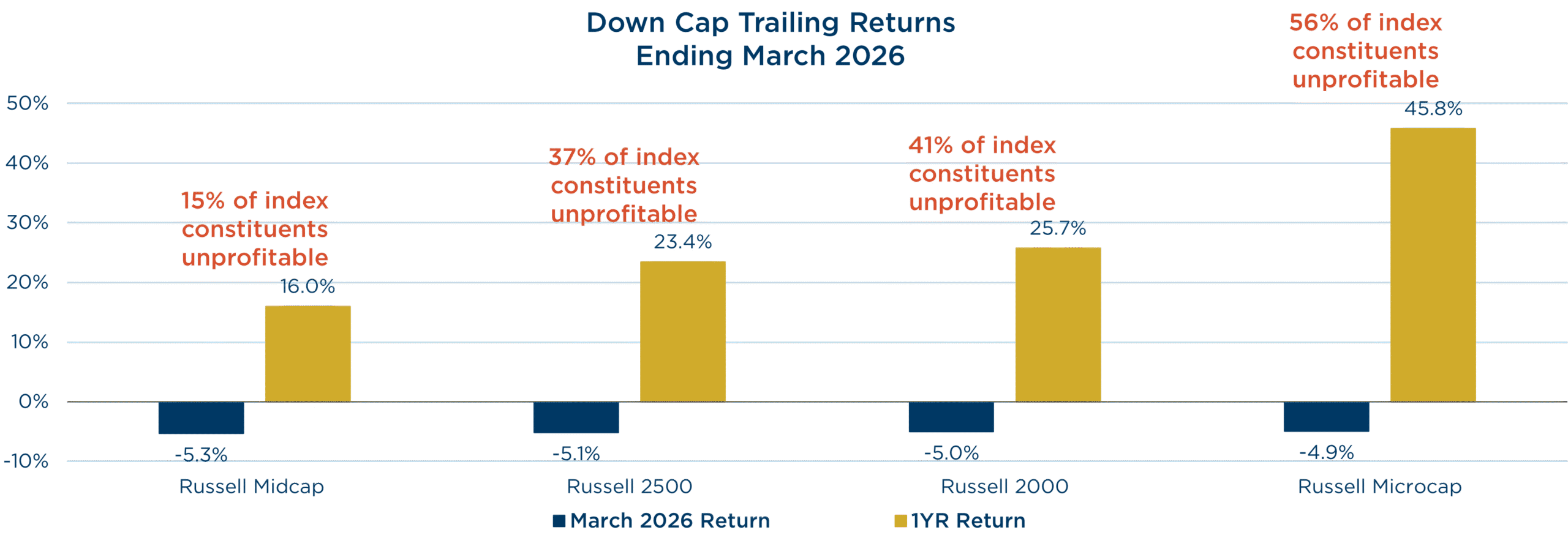
Source: eVestment & FactSet. Data from 3/31/25 – 3/31/26. Past performance should not be taken as a guarantee of future performance.
Broadening Above, Speculation Below
Q1 brought encouraging signs of broadening among U.S. large-cap securities, with market leadership expanding beyond the narrow group of mega-cap technology stocks that dominated recent years. Down cap, however, a different story has unfolded. Small and mid-cap indexes have been driven by narrow and speculative forces over the past year, with performance concentrated in companies exhibiting characteristics that historically signal elevated risk rather than sustainable opportunity.
Understanding what has driven down-cap returns over the past year, and whether those drivers appear sustainable, becomes crucial for appropriate portfolio positioning going forward.
The Profitability Paradox
One of the most striking features of down-cap performance has been the material outperformance of indexes heavily weighted toward unprofitable companies. For the one-year period ending March 2026, strategies and indexes that emphasized unprofitable or loss-making businesses delivered substantially higher returns than those focused on profitable enterprises.This pattern runs counter to fundamental investment principles.
Profitability represents the ability of a business to generate returns on invested capital and weather periods of economic stress. Yet for much of the past year, the market has rewarded speculation over earnings. Companies with compelling narratives but limited financial results have seen their valuations expand dramatically. Themes like artificial intelligence applications and biotechnology breakthroughs have captured investor imagination, driving capital toward businesses positioned at the intersection of these trends regardless of current profitability.
This dynamic has fundamentally shaped down-cap index composition and returns. As unprofitable companies have outperformed, their weights within indexes have grown, creating a feedback loop where benchmark-aware strategies gain increasing exposure to the very characteristics associated with elevated risk.
March’s Counterintuitive Resilience
Perhaps most surprising was how this pattern persisted even during periods of market stress. In March 2026, energy prices spiked and market volatility increased sharply in response to escalating conflict involving Iran. These developments created the type of risk-off environment where investors typically seek quality and stability.
Historically, such periods favor profitable companies with strong balance sheets. When uncertainty rises, the market typically reprices risk, and speculative positioning comes under pressure. March’s market behavior defied this historical pattern. Down-cap indexes with higher concentrations of unprofitable companies proved more defensive during the selloff, holding up better than indexes weighted toward profitable businesses.
This counterintuitive result suggests that speculative positioning had become so entrenched that even traditional risk-off catalysts failed to trigger the expected rotation toward quality. When even geopolitical shocks fail to shake speculative excess, it often signals that positioning has reached extremes that eventually prove unsustainable.
Sustainability Questions
Several factors suggest that recent dynamics favoring unprofitable companies down-cap may be long in the tooth. Interest rates, while lower than recent peaks, remain well above the near-zero levels that previously made unprofitable companies more palatable to investors. Without the tailwind of falling discount rates, companies need to demonstrate convincing paths to profitability.
The persistence of unprofitable company outperformance has created valuation levels that appear increasingly disconnected from fundamental reality. When loss-making businesses trade at premium valuations based primarily on narrative appeal, the margin for disappointment becomes substantial. Any evidence that growth is slowing or the path to profitability is longer than anticipated can trigger sharp valuation compression.
The historical record provides perspective. Periods when unprofitable companies materially outperform profitable ones have typically proven temporary. Eventually, fundamental factors reassert themselves, and the market rewards companies that generate earnings and cash flow. The duration of speculative periods varies, but their eventual resolution tends to be swift and painful for investors concentrated in lower-quality segments of the market.
Building Portfolios for Durability
Given these dynamics, investors may want to evaluate whether their down-cap exposures appropriately balance opportunity with sustainability. The quality of underlying holdings matters significantly. Companies with durable competitive moats, consistent profitability, and flexible balance sheets present fundamentally different risk profiles than unprofitable businesses trading on speculative themes.
Business model sustainability deserves particular attention. Companies that generate positive returns on invested capital, maintain pricing power, and operate with limited leverage possess characteristics that provide resilience across various market environments. These attributes become especially valuable when speculative excess eventually reverses.
Index construction methodology creates meaningful differences in exposure characteristics. Passive down-cap strategies inherit the composition of their underlying indexes, including whatever concentrations toward unprofitable businesses currently exist. Active strategies have the ability to construct portfolios with different characteristics, though this requires managers willing to differentiate meaningfully from benchmarks.
An Active Approach to Down-Cap Investing
At The London Company, we believe the current down-cap environment reinforces the value of active management focused on business quality and fundamental sustainability. Our investment approach emphasizes companies with durable competitive advantages, proven profitability, strong balance sheets, and reasonable valuations.
We seek businesses that generate consistent returns on invested capital across various market environments. This focus on profitability, clean balance sheets, and valuation discipline naturally limits exposure to the speculative positioning that has driven recent down-cap index returns but appears increasingly vulnerable to reversion.
This approach creates portfolios that look meaningfully different from down-cap indexes as currently constructed. We recognize that differentiation can create periods of relative performance drags when speculation dominates. However, we believe that maintaining discipline around sustainable business quality, profitability, and valuation provides a more prudent approach than chasing speculative themes, particularly when speculative positioning appears long in the tooth.
Read More Thought Capital
from The London Company