
Market Observations & Portfolio Commentary
Large Cap – 3Q2026 vs. Russell 1000 Value
Market Update
U.S. equities were mixed in the third quarter, with modest index gains but weak participation beneath the surface. The Russell 3000 returned 1.4%, but the average S&P 500 stock declined and Small Caps fell sharply. Strong earnings and improving PMIs supported Large Caps, while the breakdown of U.S.-Iran peace efforts sent oil sharply higher and reignited inflation concerns. The Fed raised rates 25 basis points in September, its first hike since 2023. Treasury yields rose across the curve, with the 10-year at its highest level since 2002. Higher oil and rates compressed valuations and weighed on consumer confidence.
Equity leadership shifted sharply during the quarter. The high-beta and the momentum rally that peaked in late June reversed, and Large Caps were the only size segment to post gains as the Russell 2000 fell 7.2%. Breadth was weak, with the Equal-Weight S&P 500 trailing its cap-weighted counterpart by more than four percentage points. Energy led all sectors as oil surged, and Technology advanced as a software rebound offset weakness in semiconductors. Utilities and Industrials lagged. From a factor perspective, Value, Quality, Size and Yield were all positive. Momentum and Volatility were negative, while Growth factors were mixed.
Key Performance Takeaways for the Year
-
The London Company Large Cap portfolio declined 3.2% (-3.4% net) during the quarter vs. a 2.6% increase in the Russell 1000 Value Index. Both stock selection and sector allocation were headwinds to relative performance.
-
The Large Cap portfolio declined modestly in Q3 while the Russell 1000 Value advanced, falling short of our 85–90% upside capture expectations. Most of the shortfall came in July and reflects unfortunate reconstitution timing rather than any shift in our approach. We missed the parabolic first-half rally in cyclical memory & semi-equipment names before the June reconstitution removed that exposure from the index, then saw no offsetting benefit when those names sharply sold off in Q3. Moreover, the Value index’s new mega-cap tech exposure experienced a resurgence during the quarter, which added further headwinds. The benchmark changed; our process did not. We believe our consistent, differentiated approach grows more valuable as the Value index takes on more growth and technology exposure than its label suggests.
Top 3 Contributors to Relative Performance
-
NewMarket Corporation (NEU) – NEU outperformed on solid results, led by strong growth in Specialty Materials serving aerospace and defense. Petroleum additives also improved, while the company reduced debt and repurchased shares. We remain attracted to NEU’s expanding defense capacity, long record of capital returns, and strong cash generation.
-
Chevron Corporation (CVX) – CVX was a top contributor as oil prices rebounded on the unresolved conflict in the Middle East and quarterly results beat expectations on stronger downstream profits. While commodity prices are elevated and outside management’s control, we continue to appreciate CVX’s disciplined capital allocation, improved prospects for long-term production growth, operational efficiency, and commitment to shareholder returns.
-
BlackRock, Inc. (BLK) – BLK was a top contributor after reporting record revenue and earnings, supported by strong inflows into its ETFs and growth in its technology services business. We remain confident BLK’s diversified platform, strong organic asset growth, and expanding margins position the company for durable long-term earnings growth.
Top 3 Detractors from Relative Performance
-
Entegris, Inc. (ENTG) – ENTG declined as semiconductor stocks pulled back after a very large run, despite a strong quarter with accelerating customer spending. We remain attracted to ENTG’s’ competitive position, high barriers to entry, and rising free cash flow as its investment cycle winds down.
-
Old Dominion Freight Line, Inc. (ODFL) – ODFL declined alongside other trucking stocks even as results improved on firmer pricing and better sequential volumes. Volumes remain soft, but management sees room to grow without adding capacity. We remain confident in ODFL’s network capacity, operating leverage, and cost structure, which should drive strong earnings growth as freight recovers.
-
Martin Marietta Materials, Inc. (MLM) – MLM declined as investors weighed the Lhoist acquisition, higher leverage, and uncertainty around the next phase of federal infrastructure funding. Underlying demand remains healthy, pricing opportunities are improving, and the company raised its revenue outlook. We continue to like its leading aggregates franchise, strong pricing power, and long runway for earnings growth.
Sector Influence
We are bottom-up stock pickers, but sector exposures influenced relative performance as follows:
-
What Helped: Overweight Communication Services (a better performing sector) & underweight Real Estate (a weaker performing sector)
-
What Hurt: Underweight Health Care (a better performing sector) & overweight Industrials (a weaker performing sector)
Trades During the Quarter
- Increased: NewMarket Corporation (NEU) – Addition reflects our confidence that AMPAC’s added capacity will generate strong incremental operating returns, which paired with management’s long record of capital returns, should reward shareholders.
Looking Ahead
The economic backdrop remains supportive in many respects. Growth is solid, manufacturing and services activity are improving, and corporate earnings continue to exceed elevated expectations. At the same time, the headwinds have grown more pronounced. The Fed has begun tightening, energy prices and Treasury yields are elevated, and higher borrowing and living costs are weighing on consumers, particularly at the lower end of the income spectrum. The AI investment cycle remains a powerful engine of growth. Yet, its scale invites comparisons to past infrastructure booms, where investors who were right about the buildout still endured significant drawdowns along the way. Early signs of stress have also emerged in the lowest tiers of credit. While we do not attempt to predict the path of rates or the economy, we believe these crosscurrents argue for discipline.
From an equity market perspective, headline index strength continues to mask a narrower reality. A concentrated group of AI-linked companies has driven a disproportionate share of returns, while many stocks have moved independently of, or opposite to, the index. Passive flows have reinforced that concentration, and benchmarks once considered defensive now carry more technology exposure and higher beta than their labels suggest. Quality has historically lagged when rates rise, but if higher rates begin to pressure corporate balance sheets, the attributes we emphasize should matter more: strong returns on capital, conservative leverage, durable dividends, and reasonable valuations. We view these attributes as important ballast and a complement to more concentrated growth exposures. We remain confident that our portfolios are well positioned to participate as fundamentals reassert themselves while helping to manage downside risk.
Annualized Returns
As of 9/30/2026
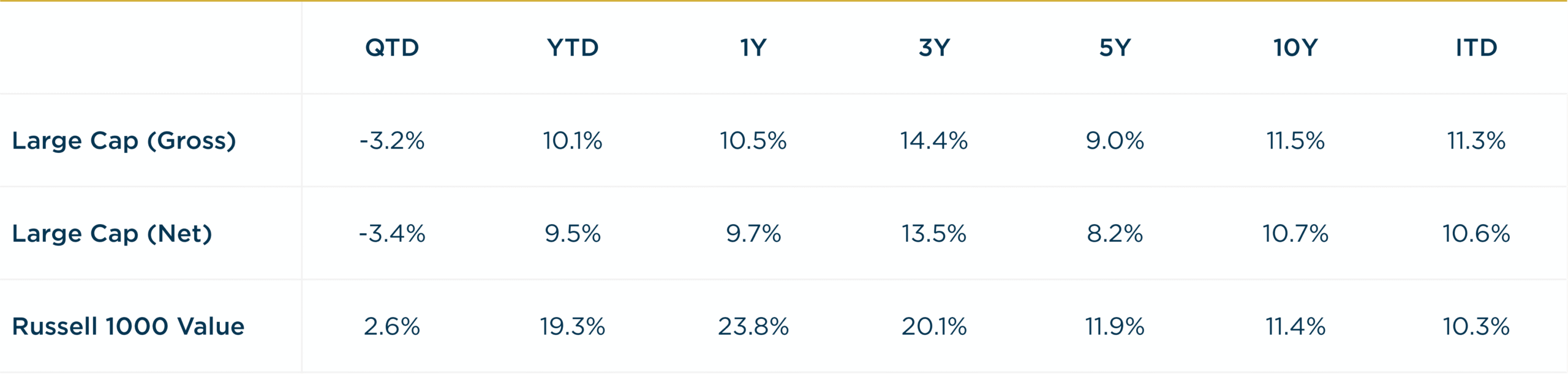
Inception date: 6/30/1994. Performance is preliminary. Subject to change. Past performance should not be taken as a guarantee of future results. Net of fee returns are calculated net of an annual model management fee of 0.75%. Please see the disclosure notes found on the bottom of the page. The Large Cap product is typically compared to the Russell 1000 Index. Any comparison to the Russell 1000 Value is for illustrative purposes only.