
Market Insights: The Crowding Out of Defensives & Dividends
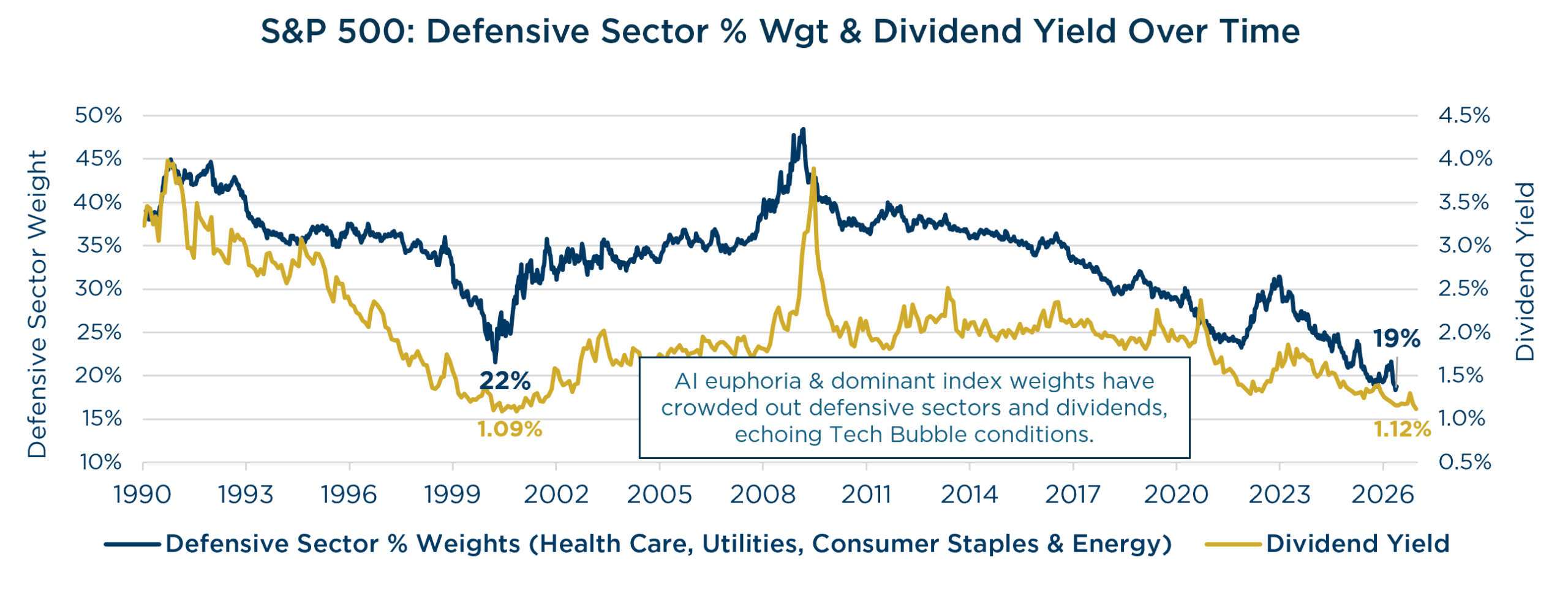
Source: Strategas & Piper Sandler. Sector data from 2/2/90 – 5/22/26 and yield data from 12/31/89 – 5/29/26. Past performance should not be taken as a guarantee of future performance.
The Crowding-Out Effect: What AI Enthusiasm May Mean for Defensive Investors
The current bull market has been remarkable in both its duration and its concentration. Fueled by enthusiasm around artificial intelligence and the infrastructure needed to support it, U.S. equity markets have increasingly rewarded a narrow set of companies — and that dynamic may carry meaningful implications for investors who rely on traditional sources of downside protection and income.
Technology Concentration at Historic Levels
The technology sector’s weight within the S&P 500 has climbed to levels that now exceed even the late 1990s dot-com era — a period most investors recognize as a cautionary example of what concentrated enthusiasm can produce. Today’s run-up is broader in some respects, extending beyond pure-play technology firms to capture what might be called first- and second-derivative AI beneficiaries: semiconductor manufacturers, power infrastructure companies, data center operators, and others whose growth is tied, at least in part, to the build-out of AI capacity.
The result is an index that looks quite different from what many investors may expect when they think of “the market.” Sector weights that were once distributed across a range of industries have shifted substantially toward growth-oriented, technology-adjacent names.
What’s Being Crowded Out
When any sector commands a disproportionate share of index weight, something else necessarily shrinks. In the current environment, the areas being crowded out are notable: defensive and counter-cyclical sectors — Utilities, Consumer Staples, Health Care, and Energy — now represent a combined weight near historic lows within the S&P 500. The index’s weighted average dividend yield has followed a similar trajectory, also sitting near multi-decade lows.
For investors who have historically used broad index exposure as a way to maintain a diversified, income-generating, or defensively balanced portfolio, this shift may warrant a closer look. The index they’re tracking today is materially different from the one they may have evaluated when making their original allocation decision.
The Implication for Downside Protection and Income
Defensive sectors and dividend-paying companies have historically served two related purposes in a portfolio: they’ve tended to hold up better during periods of market stress, and they’ve provided a stream of income that doesn’t depend on price appreciation. Neither characteristic is guaranteed, but both have been meaningful over long market cycles.
When the index underweights these characteristics, investors relying on market-cap weighted index funds for downside ballast or income generation may find that the instrument is no longer well-suited to those goals. A passive allocation that once carried a meaningful allocation to staples, utilities, or dividend payers may now look quite different under the hood.
Investors who have a specific need for income, or who are sensitive to drawdown risk — such as those in or near retirement, or institutions with spending requirements — may want to evaluate whether their current equity exposure is still aligned with those objectives.
Beyond the Index: The Case for Active, Fundamental Selection
One response to index-level distortions is to simply tilt toward defensive sectors or higher-yielding areas of the market. There’s a logic to that approach, but it carries its own limitations. Sector-level tilts can introduce concentration in a different direction, and not every company within a defensive sector is equally well-positioned — some carry elevated debt loads, face secular headwinds, or offer dividend yields that may not be sustainable.
A potentially more durable approach is one grounded in bottom-up fundamental research: identifying individual companies with the balance sheet strength, competitive positioning, and valuation discipline that may support both income generation and capital preservation across market cycles — regardless of which sector they happen to sit in. This approach requires evaluating each company on its own merits: the durability of its competitive advantages, the quality of its cash flows, and whether its dividend appears sustainable given its underlying business.
At The London Company
Within our Income Equity strategy, our investment process is built around exactly these principles. We take a concentrated, bottom-up approach focused on companies we believe possess sustainable competitive advantages, durable balance sheets, and reasonable valuations. Our goal is to construct a portfolio capable of delivering a premium dividend yield alongside meaningful downside protection — not by defaulting to defensive sectors as a category, but by identifying individual businesses we believe can deliver those characteristics on their own terms.
The current environment, in our view, illustrates why that distinction matters. Markets that reward narrow themes can create attractive opportunities in areas the index has de-emphasized — but capitalizing on those opportunities requires the analytical groundwork to evaluate them, company by company.
Read More Thought Capital
from The London Company